

Le bilinguisme est un domaine de recherche difficile, une forêt dense de variables confondantes, dont l'échantillonnage, les niveaux d'éducation, les tâches utilisées, les variations dans les langues elles-mêmes et les différents résultats des différentes combinaisons de langues, n'en sont que quelques-unes. Il est toutefois prouvé que la maîtrise de plus d'une langue apporte des avantages cognitifs en plus des possibilités accrues. Des découvertes en neurologie ont établi un lien entre l'acquisition d'une langue et des changements structurels dans le cerveau qui favorisent les fonctions exécutives telles que la flexibilité cognitive, la pensée créative et la gestion de l'attention.
Qu'est-ce que l'éducation bilingue ?
Le comportement et les perceptions humaines passent par notre langage ; les codes débloqués par l'apprentissage de nouvelles langues contribuent à créer un nouveau niveau de perception. François Grosjean, universitaire suisse de renom et expert en bilinguisme, a montré que l'enfant ou l'adulte bilingue n'est pas simplement la somme de deux (ou plusieurs) monolingues ; il est plutôt le détenteur d'une configuration linguistique unique et spécifique. Le bilingue gère et manipule son attention vers l'une ou l'autre langue, activement, mais souvent inconsciemment. Leurs langues non seulement coexistent, mais interagissent pour produire un système complet qui leur est propre.
Avantages de l'éducation bilingue
Dans le monde globalisé moderne, l’éducation bilingue joue un rôle crucial et offre des avantages distincts, en particulier pour les jeunes générations.
1. Citoyens du monde
Les personnes bilingues sont précieuses dans le monde d'aujourd'hui. Elles verront s'ouvrir de nouvelles perspectives d'emploi et élargir leurs horizons sociaux. Leur engagement envers le monde et la société dans laquelle nous vivons est riche ; leur esprit est agile.
2. Avantages psychologiques
De plus, leurs qualités vont au-delà de la simple traduction de mots d'un code à un autre ; bien connaître une autre langue apporte des bienfaits psychologiques subtils. Parmi ceux-ci, on compte la capacité de voir les deux côtés d'une histoire, d'en apprécier le sens étendu et de bénéficier d'une compréhension conceptuelle large. Ces qualités sont bénéfiques pour l'individu concerné et, surtout, contribuent à l'atteinte de cet objectif insaisissable d'harmonie internationale. Les bilingues sont des bâtisseurs de ponts, des intermédiaires capables d'expliquer une culture aux membres de l'autre et de servir d'intermédiaires entre les deux.
3. Compétences linguistiques
La scolarisation internationale a contribué à renforcer les compétences linguistiques. À mesure que les familles se mondialisent et que de plus en plus de jeunes voyagent pour leurs études et leur travail, ils peuvent rencontrer un futur partenaire loin de leur pays de naissance, ce qui se traduit par un plus grand nombre de familles multiculturelles partageant plusieurs langues au sein de leurs foyers internationaux. Alors que nous sommes confrontés à la domination d'une seule langue dans de vastes domaines de l'activité humaine, l'anglais étant la langue 1 ou 2 pour de nombreux étudiants, voire pour la plupart d'entre eux, il est fascinant de constater que de plus en plus de versions de l'anglais sont reconnues. La population de citoyens du monde partageant les avantages de diverses formes de bilinguisme est en augmentation.
4. Comprendre les cultures
Outre les avantages fonctionnels de l'apprentissage des langues, le bilinguisme permet de comprendre les cultures. En créant son système linguistique unique, le bilingue donne également un sens à sa relation avec les deux cultures auxquelles son code linguistique lui a donné accès. En même temps qu'il gère son attention sur ce code, son vocabulaire et sa syntaxe, le bilingue sera attentif aux variantes culturelles entre les langues. Il combine et mélange constamment des aspects des cultures qu'il vit, faisant des choix linguistiques et culturels en fonction des besoins de la situation.
Il en résulte un "espace intermédiaire", comme l'habitat des enfants de la troisième culture. L'idée des enfants de la troisième culture a été développée pour faire référence aux enfants qui grandissent en dehors du pays d'origine de leurs parents (qui étaient souvent eux-mêmes expatriés). Ils font partie d'une troisième culture plutôt que d'une culture issue d'un simple mélange entre le pays d'origine et le pays d'accueil.
Bilinguals as Bridge Builders
Francois Grosjean points out that bilinguals who are allowed to be who they are, and to accept their dual (or multiple) lived experiences, are invaluable members of society who bridge the gap between the cultures they belong to. This is an important role played by the sort of educational provision to be found at Institut Montana.
Continue reading
Bilinguals as Bridge Builders
Francois Grosjean points out that bilinguals who are allowed to be who they are, and to accept their dual (or multiple) lived experiences, are invaluable members of society who bridge the gap between the cultures they belong to. This is an important role played by the sort of educational provision to be found at Institut Montana.
Continue reading
La classe bilingue
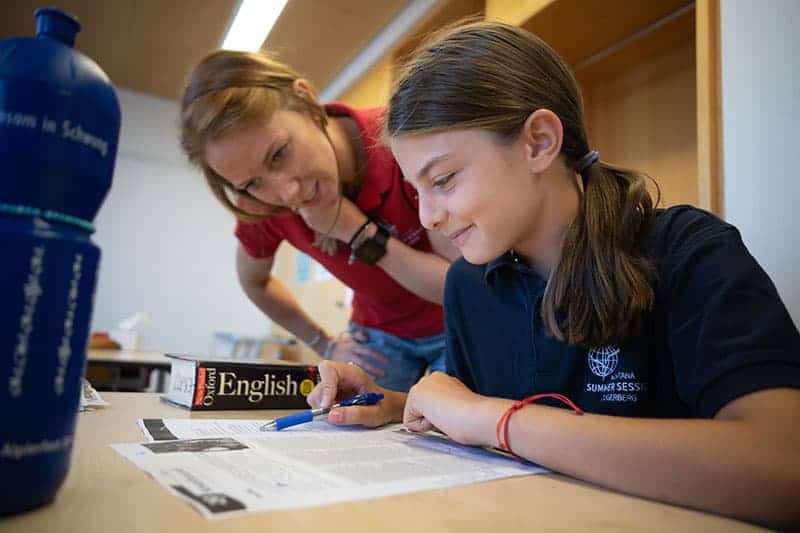
La classe bilingue est un lieu inspirant. Le simple fait de voir les travaux scolaires des enfants exposés, avec des légendes et des étiquettes démontrant la maîtrise de deux langues, est une source d'inspiration. Mais cela ne se fait pas tout seul et la qualité de l'enseignement est essentielle - chaque enfant doit se sentir heureux et confiant pour être ouvert aux défis et aux avantages de l'apprentissage du bilinguisme. La recherche sur le cerveau bilingue oriente les méthodes d'enseignement. On sait aujourd'hui que ces enfants utilisent les deux langues pour comprendre le monde ; ils s'adaptent très bien, approfondissant leur compréhension de la première langue tout en acquérant la seconde ; et le processus a des effets positifs importants sur d'autres aspects du développement cognitif, tels que la gestion de l'attention.
A Tradition of International Education
The Bilingual Elementary section of Institut Montana has the school’s long history of international education on which to draw, as well as the dedication and expertise of its staff. Teaching in the bilingual classroom requires a thorough approach, with plenty of individual assessment and on-going help. Quality teaching comes from using evidence-based principles of instruction, such as teacher modelling and verbalizations, guided practice, and brisk lesson pacing to maintain student engagement.
Continue reading
Tailored Support for Every Child
The Montana Elementary school classrooms are tucked away in a pretty corner of the magnificent Institut Montana campus. As soon as a new child arrives, their language needs are quickly assessed and appropriate support organised. It might be that the child has some skills but needs in-class support to benefit fully from the lesson. In this case, teachers deploy the integrative EAL (for English) or DaZ (for German) programme where support is provided by an additional teacher within the normal classroom following the standard lessons. If the child would benefit from more intensive language tuition, they receive help specially tailored to their needs. For half of the English or German language lessons, they work with an extra teacher outside the classroom so that they quickly learn the foundational skills to enable rapid progress in the new language and find the subject matter within their reach. For the other half they continue to participate in normal lessons so that they can interact with their peers.
Continue reading
Balancing Languages and Identities
In this multi-lingual group of young learners, it is important not to hold up one language, and therefore cultural identity, as superior to another. Seeing one of the languages and its culture as the dominant one is counter-productive to the cultural harmony the bilingual classroom seeks to promote, even when the curriculum followed belongs to one of the languages. The Institut Montana Bilingual Elementary School follows the curriculum of its home country, Switzerland, but the balance between the two languages is scrupulously maintained. Teaching is distributed at 50% of the time for each language. Each academic year the groups change Class Advisors, swapping between German and English speaking, so there is a further balance in exposure to both languages.
Continue reading
A Tradition of International Education
The Bilingual Elementary section of Institut Montana has the school’s long history of international education on which to draw, as well as the dedication and expertise of its staff. Teaching in the bilingual classroom requires a thorough approach, with plenty of individual assessment and on-going help. Quality teaching comes from using evidence-based principles of instruction, such as teacher modelling and verbalizations, guided practice, and brisk lesson pacing to maintain student engagement.
Continue reading
Tailored Support for Every Child
The Montana Elementary school classrooms are tucked away in a pretty corner of the magnificent Institut Montana campus. As soon as a new child arrives, their language needs are quickly assessed and appropriate support organised. It might be that the child has some skills but needs in-class support to benefit fully from the lesson. In this case, teachers deploy the integrative EAL (for English) or DaZ (for German) programme where support is provided by an additional teacher within the normal classroom following the standard lessons. If the child would benefit from more intensive language tuition, they receive help specially tailored to their needs. For half of the English or German language lessons, they work with an extra teacher outside the classroom so that they quickly learn the foundational skills to enable rapid progress in the new language and find the subject matter within their reach. For the other half they continue to participate in normal lessons so that they can interact with their peers.
Continue reading
Balancing Languages and Identities
In this multi-lingual group of young learners, it is important not to hold up one language, and therefore cultural identity, as superior to another. Seeing one of the languages and its culture as the dominant one is counter-productive to the cultural harmony the bilingual classroom seeks to promote, even when the curriculum followed belongs to one of the languages. The Institut Montana Bilingual Elementary School follows the curriculum of its home country, Switzerland, but the balance between the two languages is scrupulously maintained. Teaching is distributed at 50% of the time for each language. Each academic year the groups change Class Advisors, swapping between German and English speaking, so there is a further balance in exposure to both languages.
Continue reading
Un avenir radieux
Il ne fait aucun doute que l'apprentissage d'une nouvelle langue élargit les horizons et apporte une compétence utile. En outre, il apporte de grands avantages cognitifs qui, bien qu'ils soient soumis à trop de variables pour être distingués, sont réels et significatifs.
Pathways to Global Opportunities
At Institut Montana, as they reach the end of their years at the Elementary School, these children greet a world of opportunity. They have the advanced skills in German that open the door to the academically demanding Swiss Matura, which they can choose to study in German or German and English. They can embark on the route towards the International Baccalaureate Diploma, a passport to universities all over the world. Or they can continue their bilingual studies at the Bilingual Secondary School while assessing where their ambitions might take them.
Continue reading
Pathways to Global Opportunities
At Institut Montana, as they reach the end of their years at the Elementary School, these children greet a world of opportunity. They have the advanced skills in German that open the door to the academically demanding Swiss Matura, which they can choose to study in German or German and English. They can embark on the route towards the International Baccalaureate Diploma, a passport to universities all over the world. Or they can continue their bilingual studies at the Bilingual Secondary School while assessing where their ambitions might take them.
Continue reading
Résumé
Les enfants qui se réunissent pour apprendre, jouer et collaborer dans un espace où les deux langues sont monnaie courante créent un espace hybride avec une culture qui n'appartient ni à l'une ni à l'autre. La classe bilingue est un espace d'inclusion, où les idées sur l'identité culturelle sont éclairées d'un jour nouveau. Ses élèves seront les citoyens du monde de demain, des adultes à l'esprit large et perspicace, capables de partager et de discuter des connaissances dans un environnement multiculturel et parfaitement à l'aise dans une réunion internationale Zoom. Pour ces enfants brillants, l'avenir est prometteur.
Ce que disent les écoles
Les écoles ayant une expérience pratique sur ce sujet partagent leur point de vue.
Bilinguals as Bridge Builders
Francois Grosjean points out that bilinguals who are allowed to be who they are, and to accept their dual (or multiple) lived experiences, are invaluable members of society who bridge the gap between the cultures they belong to. This is an important role played by the sort of educational provision to be found at Institut Montana.
Continue reading
A Tradition of International Education
The Bilingual Elementary section of Institut Montana has the school’s long history of international education on which to draw, as well as the dedication and expertise of its staff. Teaching in the bilingual classroom requires a thorough approach, with plenty of individual assessment and on-going help. Quality teaching comes from using evidence-based principles of instruction, such as teacher modelling and verbalizations, guided practice, and brisk lesson pacing to maintain student engagement.
Continue reading
Tailored Support for Every Child
The Montana Elementary school classrooms are tucked away in a pretty corner of the magnificent Institut Montana campus. As soon as a new child arrives, their language needs are quickly assessed and appropriate support organised. It might be that the child has some skills but needs in-class support to benefit fully from the lesson. In this case, teachers deploy the integrative EAL (for English) or DaZ (for German) programme where support is provided by an additional teacher within the normal classroom following the standard lessons. If the child would benefit from more intensive language tuition, they receive help specially tailored to their needs. For half of the English or German language lessons, they work with an extra teacher outside the classroom so that they quickly learn the foundational skills to enable rapid progress in the new language and find the subject matter within their reach. For the other half they continue to participate in normal lessons so that they can interact with their peers.
Continue reading
Balancing Languages and Identities
In this multi-lingual group of young learners, it is important not to hold up one language, and therefore cultural identity, as superior to another. Seeing one of the languages and its culture as the dominant one is counter-productive to the cultural harmony the bilingual classroom seeks to promote, even when the curriculum followed belongs to one of the languages. The Institut Montana Bilingual Elementary School follows the curriculum of its home country, Switzerland, but the balance between the two languages is scrupulously maintained. Teaching is distributed at 50% of the time for each language. Each academic year the groups change Class Advisors, swapping between German and English speaking, so there is a further balance in exposure to both languages.
Continue reading

Alexander Peipers est cofondateur et directeur général de World Schools et Camps du mondeoù il dirige une mission visant à fournir aux familles des conseils fiables dans le choix des écoles et des programmes qui favorisent l'excellence académique, la diversité culturelle et le développement holistique.
Trouvez votre nouvelle école
Emplacement
N'importe où
Type d'école
N'importe quelle école