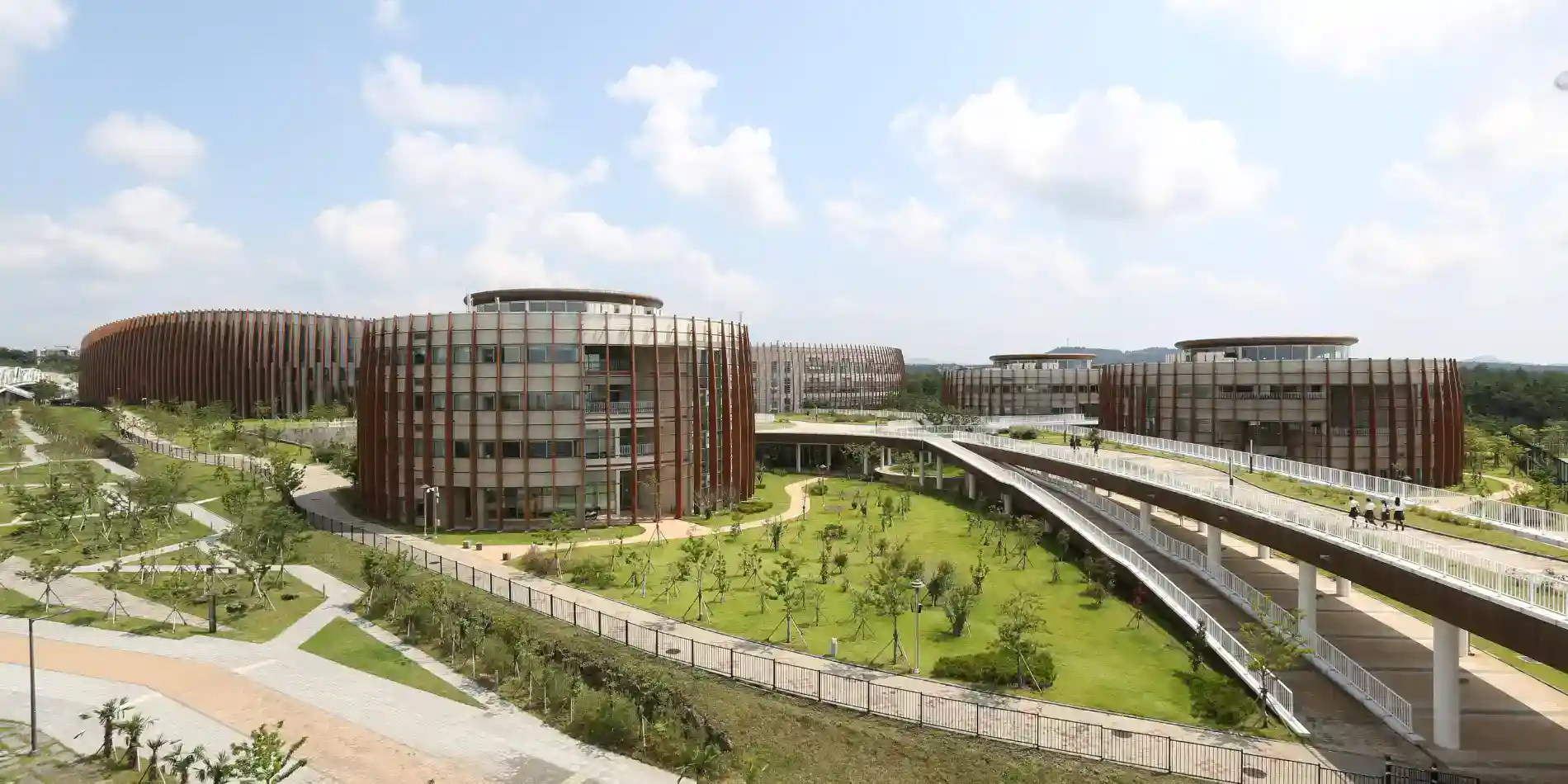
Branksome Hall Asia, an international private school in Jeju, is known for its inquiry-based and interdisciplinary approach emphasized across all three IB programs: the Primary Years Programme (PYP), the Middle Years Programme (MYP), and the Diploma Programme (DP). Among these, the MYP is a crucial stage for students to explore their interests and strengths through direct experiences in diverse academic fields. We spoke with John Palmasano, MYP Coordinator at Branksome Hall Asia, about interdisciplinary projects and experiential learning.
Palmasano, who holds a bachelor’s degree in business from Susquehanna University and a master’s in education from Lehigh University, previously worked as a digital marketer in the pharmaceutical industry and has taught in public schools in Korea as well as IB schools in Korea and Thailand.
“At school, students learn subjects like math, science, and social studies from different teachers. But the problems we face in the real world don’t come neatly divided into subjects. Many real-world challenges require integrating knowledge from multiple disciplines, so understanding and solving them demands the ability to connect different fields.”
He explained that interdisciplinary learning is built into the IB curriculum to make education more closely aligned with reality. While BHA’s MYP still follows a subject-based model, it stands out by embedding interdisciplinary learning throughout the curriculum.
“The most exciting part of interdisciplinary learning,” he said, “is that students can experience how knowledge actually works in real contexts. It helps them understand the value of what they’re learning, compare ideas, and develop multiple perspectives.”
To make interdisciplinary learning possible, teachers from different subjects collaborate to design, coordinate, and assess learning units. Examples include combining STEM subjects to form engineering-focused units, merging art with other disciplines, or integrating humanities, languages, and arts into projects exploring human expression. Palmasano cited projects where students designed their own wind turbines, requiring math, science, and design skills, or created biomimicry designs by combining engineering and biology — approaches that mirror how experts tackle real-world problems.
Student assessment focuses on criteria such as disciplinary knowledge, research, critical thinking, planning, inquiry, and reflection. The goal is to evaluate students’ individual achievements rather than comparing them to their peers.
“Teachers look for how students apply knowledge, approach problems, exercise curiosity and influence, and bring their ideas to life throughout a project,” he explained. “Our aim is for every student to reach their potential and grow by achieving meaningful results.”
As students progress through the grades, they develop deeper understanding and more complex thinking. Teachers observe and evaluate this qualitatively, setting clear expectations early on and providing continuous feedback — a key part of the assessment process.
BHA uses both formative assessment, which focuses on feedback and growth, and summative assessment, which measures overall achievement. In interdisciplinary units, additional criteria evaluate how well students synthesize ideas across subjects. IB’s interdisciplinary assessment guidelines value subject understanding, integrative thinking, and reflection.
Palmasano showcased a multidimensional evaluation model that breaks down categories such as creative thinking, critical thinking, and communication into detailed criteria. For example, disciplinary knowledge includes comprehension, inquiry, and analysis; creative thinking includes development, creation, and outcomes; and critical thinking includes analysis, critique, pattern investigation, and applying math to real-world problems.
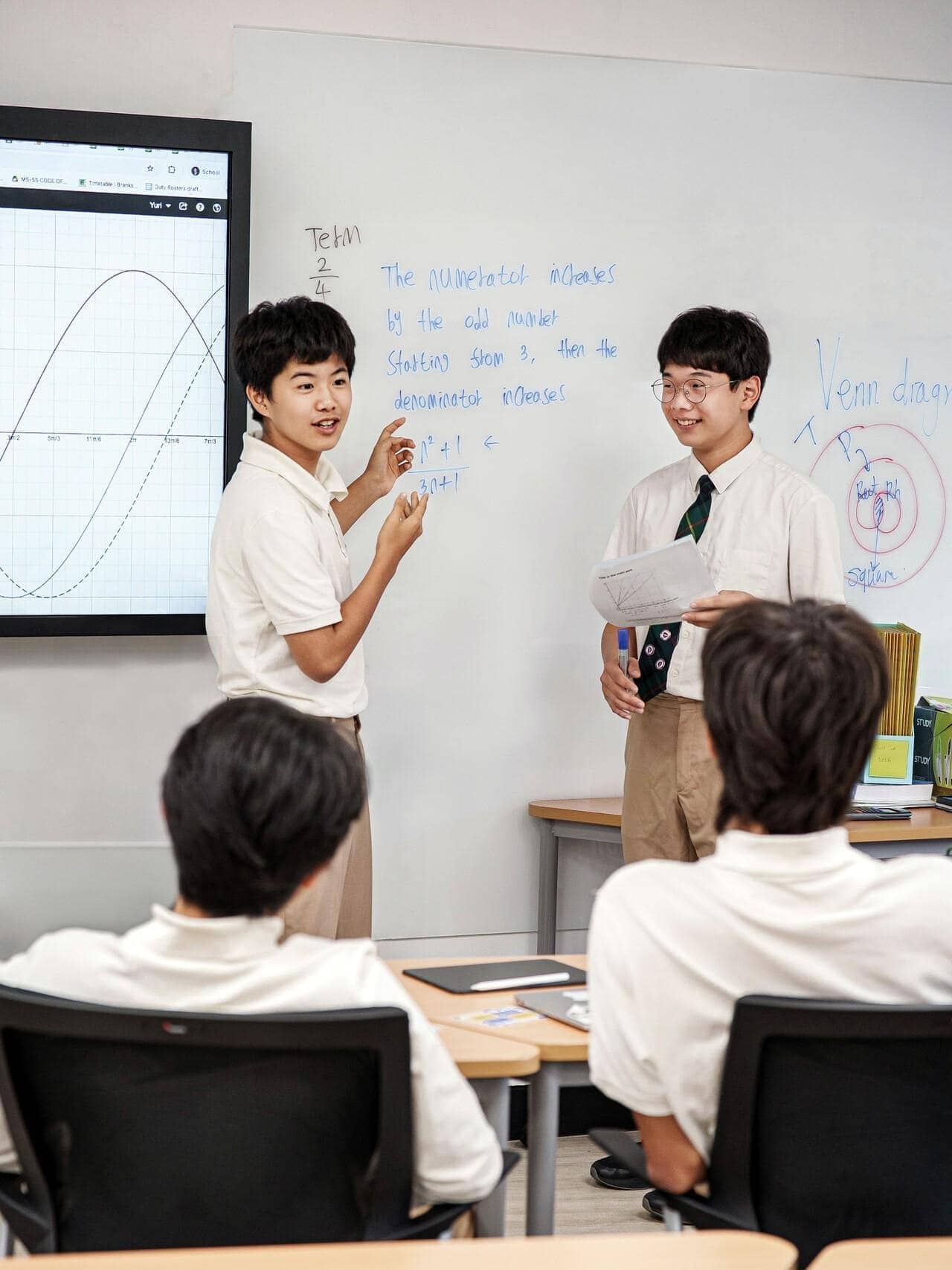
Math class of Grade 9 male students who completed the Middle Years Programme at Branksome Hall Asia this year and advanced to the Diploma Programme.
Experience-Based Learning: Building Growth and Resilience
Branksome Hall Asia extends learning beyond the classroom through experiential learning, including community service projects where students engage with Jeju’s local community and propose solutions to real issues.
“The purpose of experiential learning is to build genuine connections between classroom learning and the real world, so students realize the value of what they learn,” Palmasano said. “Through service, they can see how their actions impact the world — an invaluable lesson.”
To expand these experiences, BHA runs the Week Without Walls (WWW) program, where students leave campus for 1–3 weeks to explore and experience the world in various settings. Traditionally, BHA’s experiential learning included a three-week exchange program (BHX) for DP1 students at Branksome Hall in Ontario, Canada. There, students conduct interdisciplinary research with Canadian peers, broaden their academic perspectives, and build cross-cultural understanding and friendships. The WWW program has since expanded to include MYP students and a wider range of destinations worldwide.
“One of the most positive outcomes is that students learn how to build meaningful relationships with people they meet during these trips,” he said. “They mature through cultural exchange and gain early exposure to overseas academic environments — helpful preparation for studying abroad.”
Palmasano noted that such experiences significantly boost students’ self-growth and resilience.
“We call short-term experiential programs a ‘sprint for resilience’ and the three-week exchange a ‘marathon for endurance.’ Students return better prepared for challenges like exams and university applications, realizing that academics are just one part of life.”
For the first time this year, male students joined the Canada exchange program. They participated in the same activities, including outdoor camps, and joined a new Design Thinking & Social Entrepreneurship Challenge with I-think Together, a Toronto-based nonprofit. The challenge asked how AI could improve the initial experiences of international students at the University of Toronto — a real-world problem integrating AI, design thinking, and entrepreneurship.
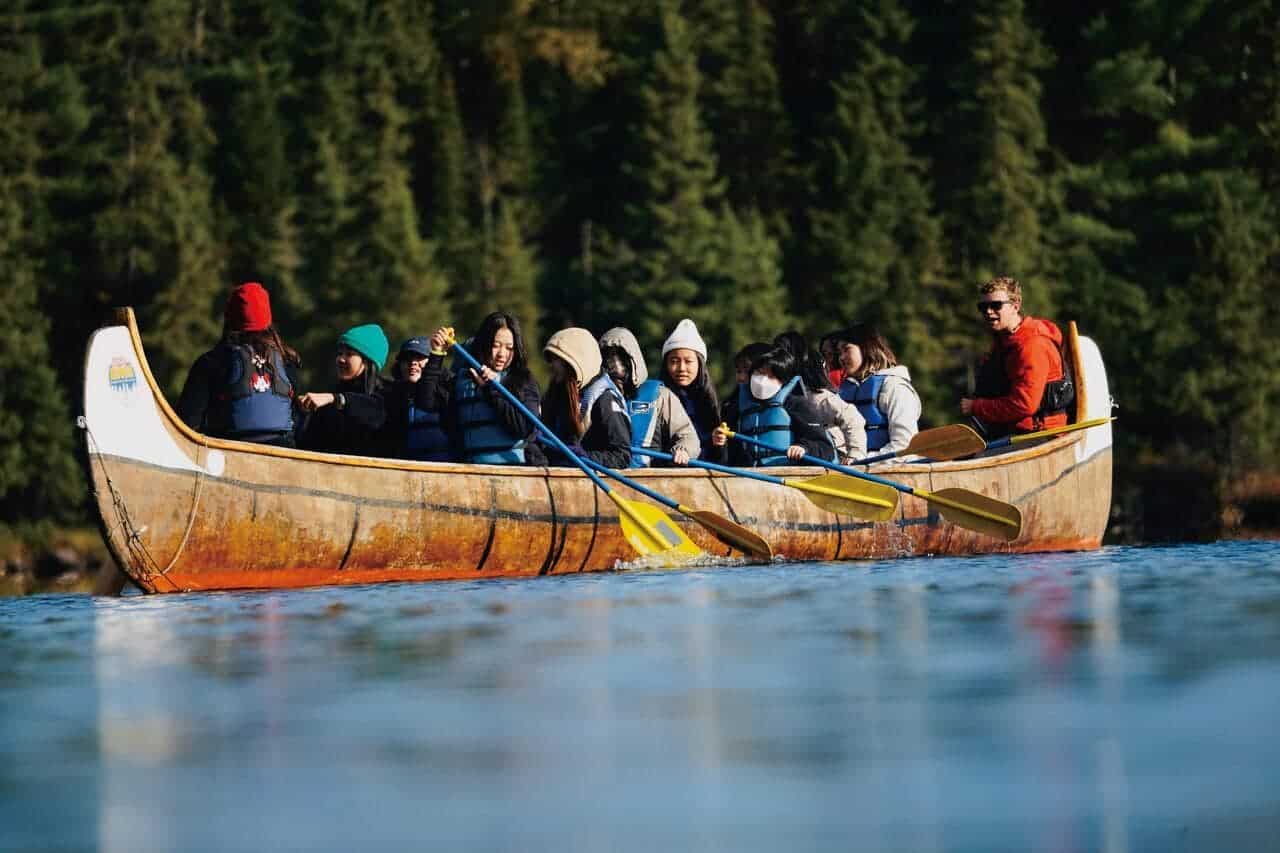
Branksome Hall Asia students participating in the Canada exchange program are canoeing as part of an outdoor activity.
Tiger Woods vs. Roger Federer: Exploring Before Specializing
At BHA, students are encouraged not to commit too early to a single field but to explore broadly before focusing. Palmasano compared this to two different athletic success stories:
“Tiger Woods picked up a golf club at three and became a legend. Roger Federer, on the other hand, played dozens of sports before choosing tennis in his late teens. By exploring widely, he built diverse skills, reflexes, perspectives, and values — and then combined them all into tennis.”
Palmasano referenced David Epstein’s book Range, which argues that generalists who explore broadly often succeed more and adapt better than early specialists. Diverse experiences nurture problem-solving, creativity, and adaptability in complex, fast-changing environments.
“We encourage students to become versatile before choosing a field. In middle and high school, deep academic exploration is important, but so is broadening understanding across disciplines before committing to a major.”